
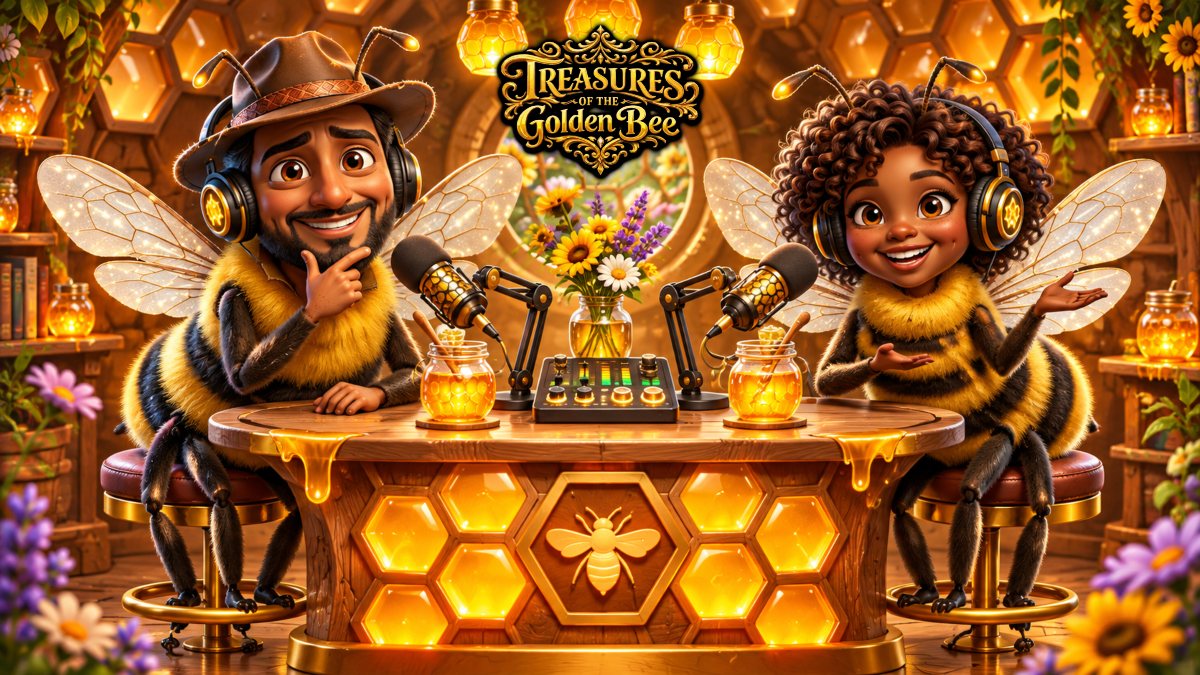
One Million Families Bypass Hollywood
What if the next great animated family film wasn’t decided in a Hollywood boardroom, but built by the families who will watch it? In this episode, our hosts take a deep dive into the vision behind Treasures of the Golden Bee: a community-built animated universe powered by one million families.
They break down why big-studio economics push movies toward safe, one-size-fits-all formulas, and how a membership model, more like a neighborhood farm co-op than a supermarket, lets families help bring a story to life from the ground up. They also explore the heart of the film: an adventure about protecting our bees and the world they help sustain.
Most of all, it’s about legacy. One day, when a child asks, “Who made this movie?” the answer could be: your family did.
Ready to be part of the story? Become a Producer today.
Read the Transcript
Transcript of the podcast episode “One Million Families Bypass Hollywood,” a conversation between two hosts.
Imagine for a second, right, that you are standing outside those iconic iron gates of a massive legacy Hollywood movie studio. You know the kind.
Oh, yeah. The towering walls, the security booths.
Exactly. And there’s this sprawling lot inside that you just, you know, you can’t quite see. And for roughly a century, that is where the magic has happened. And you, the audience, have strictly remained on the outside.
You’re just a visitor.
Right? Every so often, a tiny group of executives inside, they roll out a finished movie, you buy a ticket, you watch it, you go home. It is strictly a one-way street.
It’s very controlled.
Highly controlled. So, welcome to the deep dive, because today we’re looking at a group of creators who are trying to bypass those gates entirely. They are trying to get 1 million families to directly fund and build the next giant animated universe, like, from the ground up.
And tying it directly to a publicly traded corporate stock to make it happen, which is…
Which is wild. We will definitely get into that, but yeah, okay, let’s unpack this, because the core concept we are exploring today is just a massive, ambitious pitch.
It really is a complete inversion of the traditional media pipeline. We are talking about dismantling a top-down system that has been the global standard for decades, really.
Right. And they want to replace it with this decentralized grassroots structure.
It’s attempting to shift the absolute center of power away from, you know, a boardroom in California and drop it directly into your family living room.
Which sounds great, but I like to think of the traditional studio system as, well, as a walled garden. It’s beautiful. Sure. The executives plant the seeds, they hire the landscapers, and they open the gates for a few hours so we can all walk through and admire the flowers.
But we are just visitors.
Exactly. We are just visitors. If we wanted roses and they planted tulips, well, we’re just out of luck. That’s what we get.
And to be fair, sometimes that traditional system creates absolute timeless classics.
Well, for sure.
But it also means a lot of incredibly meaningful stories just never make it to the screen because the gatekeepers say no.
Right. So, the model being pitched in our sources today is entirely different. It’s more like a community garden.
I like that analogy.
Yeah. Where everyday supporters aren’t just visitors, they are the ones getting their hands dirty in the soil. They are founding members of the franchise.
And that’s a great way to visualize the emotional shift. But we also really have to look at the mechanical shift here, because the reason this model is so disruptive, it comes down to pure economics.
Okay, lay it on me.
So, think about the math of a modern studio tentpole movie. A studio spends, say, $200 million making an animated movie…
Which is a crazy amount of money.
It’s staggering. And then they spend another hundred million just marketing it.
Wow.
So, just to break even, just to not lose money, they need a global box office of half a billion dollars. And to get that, the movie has to appeal to literally everyone on Earth. Right. Which means you have to sand down all the edges. You can’t take any big creative risks when half a billion dollars is on the line.
Exactly. The required scale of the financial return basically dictates the art. It forces this very specific, very safe mass-market formula.
So it’s art by committee.
Pretty much. But look at the math of this proposed community model. What’s fascinating here is that if you get 1 million families to back a project directly through, you know, membership tiers, you don’t need a half-billion-dollar box office to validate its existence.
Because the funding is already secured by the core audience.
Right. You bypass the mass-market requirement entirely. The art only needs to appeal deeply and authentically to those 1 million backers.
That makes a lot of sense.
That economic reality, it changes the fundamental type of art that can be made. It allows for specificity, for weird ideas, for stories that actually mean something to a core group of people.
I hear that. But I have to admit, when I first started reading through the sources, I had some major pushback.
No, I don’t blame you.
Yeah. I just thought, wait a minute, is this just a dressed-up transaction? You know, tiers of involvement, like a Kickstarter campaign.
Right. Where you just pre-order the thing.
Exactly. Where $10 gets me a digital sticker and $500 gets my name buried in the credits in tiny font. Because, I mean, we’ve had that model for 15 years now. What is the actual mechanism making this different from just pre-ordering a digital download?
That is the exact right question to ask, because if it’s just a pre-order, it’s not a revolution. It’s literally just retail.
Right.
The difference here, according to the text, lies in the architecture of the membership itself. It’s kind of the difference between shopping at a mega supermarket and joining a neighborhood farm co-op.
Okay, break that down for me. How so?
Well, in a mega supermarket, you are purely a consumer. You exchange money for a finished good, like a tomato, and your relationship with the store ends at the cash register.
Sure.
But in a farm co-op, you are buying a share of the operation itself. You aren’t just buying tomatoes, you are providing the capital that allows the tomatoes to be planted in the first place.
Oh, okay.
And the tiers in this project, they range from entry-level supporters all the way up to what they call legacy-level contributors. They are designed to mimic that co-op structure. Members are granted actual participation in the ecosystem.
So, they aren’t just buying early access.
No, they are buying into the origin story of the intellectual property itself.
But practically speaking, I mean, how does that work without becoming a complete logistical nightmare?
What do you mean?
Well, if I’m a founding member, do I get to pick the color of the main character’s shoes? Because a million people voting on creative decisions sounds like a recipe for absolute chaos.
Oh, it would be a total disaster. But co-creation in this context doesn’t mean micromanaging the animators.
Okay, good.
Yeah, the membership tiers dictate the structural and financial foundation, not line-by-line script approvals. The co-op analogy really holds up here. The members ensure the farm exists. They might vote on the broad direction of the season’s crops, but they still hire expert farmers to actually drive the tractors.
Right. You let the artists be artists.
Exactly. The emotional ownership comes from knowing that your capital and your belief made the existence of the art possible. You are an active stakeholder in the project’s existence, not a passive consumer of its output.
Okay, so the community garden, farm co-op idea sounds really great in theory, but to actually get a million families on board, you can’t just pitch a financial model, right? You need a story they actually care about.
You need a hook.
Right. What is the actual hook of the movie they are using to launch this whole system?
So, the flagship project is an animated family film called Treasures of the Golden Bee.
Treasures of the Golden Bee. Okay.
And they are aiming high with this one. The pitch outlines a sprawling, highly cinematic universe built around adventure, discovery, and imagination.
Sounds like standard family fare so far.
It does. But what makes it a perfect test case for this community model is that it’s anchored to a very specific real-world mission.
The environmental aspect.
Yes, the entire narrative is explicitly about environmental stewardship, specifically focused on protecting the future of our bees. It aims to bring real awareness to the next generation about how crucial bees are to the world.
Which is brilliant. Honestly, bees are this perfect microcosm for the global environment. You don’t have to explain complex atmospheric science to a six-year-old.
No, that would never work.
Right. You just explain that without the bees, the flowers and the food go away. It’s tangible. You have this massive imaginative world, but it’s anchored to a real, pressing issue that parents actually want to talk to their kids about.
It creates a shared value system. And remember, they need 1 million families to care deeply enough to open their wallets before the movie even exists.
Right. You don’t get that level of commitment with a generic, safe story.
Exactly. You get it by aligning the entertainment with the actual values of the audience. The environmental mission isn’t just a plot point. It’s the catalyst for the community forming in the first place.
Okay. But here is where things take a very sharp, very strange turn in the sources.
The anomaly.
Yeah, the anomaly. Because as I was reading through the pitch, right in the middle of all this warm, fuzzy language about grandparents saving the bees for their grandkids, I hit a detail that actually made me do a double take.
It stands out for sure.
It’s a highly specific corporate callout. One of the core elements explicitly highlighted in the text is this exact phrase: Pollen Pak by URBT Corporation, stock symbol URBT.
Yes. And if we connect this to the bigger picture, that is the detail that completely reframes this entire endeavor.
Wait, hold on. Because a second ago we were talking about this pure grassroots, anti-Hollywood co-op, and now we are literally pitching a corporate stock symbol.
It does feel a bit jarring at first glance.
Doesn’t that completely ruin the grassroots vibe they were going for? It almost feels like a glitch in the matrix. I mean, what even is Pollen Pak?
Well, it’s a fascinating, deliberate collision of two worlds that are usually kept totally separate. URBT Corporation is a publicly traded entity, and Pollen Pak is their specific commercial product. It’s presumably tied directly into this agricultural or environmental space.
Okay.
So, what we are looking at here isn’t traditional product placement.
Right. It’s not like making sure the main character drinks a Coke on screen and the label is facing the camera.
Exactly. Traditional product placement is an afterthought. It’s just a way to shave a few million off the production budget. But this is structural alignment. They are overtly integrating a publicly traded corporate entity and its specific product into the DNA of the project’s pitch.
But why? Why risk alienating the indie-minded families who just want a nice community-funded movie about saving the bees?
Because it solves the most difficult part of the community funding model: financial viability and scale. By explicitly linking the animated universe to URBT Corporation and Pollen Pak, they are creating a hybrid ecosystem.
Okay, I think I see where this is going.
Yeah, they are essentially saying, we don’t have a massive Hollywood studio backing us, so we are going to leverage the infrastructure and capital of a real-world corporate entity whose mission aligns with our narrative.
It’s wildly transparent. They aren’t hiding behind a shell company or pretending it’s purely a charity.
No, not at all.
They are putting the literal stock ticker out there, essentially telling the community, “This is the corporate engine helping drive the environmental message.” It blurs the lines completely.
It really does. You aren’t just a fan of an animated movie anymore. You are an environmental advocate, a community member, and potentially even an investor or consumer of this specific publicly traded company.
That is wild.
And that is exactly what makes this a truly modern media experiment. The traditional binary says a project is either entirely a pure indie darling or it is a soulless corporate cash grab.
Right. There’s no middle ground.
Exactly. But this model rejects that binary. It attempts to bring community funding, environmental advocacy, and corporate branding under one single roof. It is a highly integrated, 21st-century approach to building a media empire.
It’s a massive gamble. But let’s step back from the corporate mechanics and the stock tickers for a second, because we still haven’t answered the most fundamental question here.
Which is?
Why are families the target for this? I mean, why would a parent who is already stretched thin want to become a founding member of an animated movie ecosystem?
That’s a great point. And the pitch offers a really poignant diagnosis of the current cultural landscape to answer that.
Okay.
They argue that families today are not searching for more content. They are searching for, quote, “more connection and more imagination.”
Not more content. That phrase really struck me when I read it, because if you look around, we are absolutely drowning in content.
Oh, we are flooded with it. The algorithms on every streaming platform are constantly serving up endless streams of videos. They autoplay the next brightly colored distraction before the credits even finish rolling on the last one.
It never stops.
It’s infinite, but it feels completely hollow.
Because it is inherently disposable. The modern media landscape is built on a model of infinite retention. It’s just about keeping your eyeballs glued to the screen for as long as possible.
Right. It’s not about quality. It’s about watch time.
Exactly. It is not built on resonance. The pitch suggests that modern families are experiencing acute digital fatigue. They are looking to recapture the feeling of generations past, where certain stories weren’t just background noise, but they became actual physical traditions in a household.
I remember that feeling so well. The golden age of physical media. A specific movie was an actual event.
Yes.
It was the VHS tape you watched together every holiday. The characters became part of the actual fabric of your childhood, basically because you chose to physically return to that world again and again.
Exactly. It was intentional, not algorithmic. And families are desperate to find that feeling of timelessness again.
But how does the act of opening your wallet to fund a movie actually bridge that gap? I can understand wanting better stories, but how does the financial mechanism of membership actually change a family’s emotional connection to the art itself?
This raises an important question about the psychology of co-creation. Think about it. When you are just a consumer, even a consumer of something great, your relationship with the media is entirely passive.
Right. You watch it, you enjoy it, you move on.
You consume it, you might critique it, and then you move on. But membership, as we discussed with the co-op analogy, it changes the emotional value of the art entirely. It transitions the family from being viewers to being stakeholders.
So, it’s really about legacy.
Precisely. Years from now, when children revisit Treasures of the Golden Bee, the parents and grandparents who supported this project won’t just be remembering a good story…
…they helped make it.
Exactly. They will know for a fact that they actively participated in bringing that story into the world. Their early belief is quite literally the reason the art exists.
It’s the ultimate sense of ownership. You aren’t just sitting in the theater being entertained. Your family’s commitment is woven into the very foundation of the film.
It is.
Which brings me to what I think is the single most powerful vision outlined in this entire pitch. They pose this scenario for the future. Imagine the day this movie is finished, and you are sitting on the couch watching Treasures of the Golden Bee with a child, and that child turns to you and asks, “Who made this movie?”
And under the legacy model, the answer to that question is always a monolithic corporation.
Right. A giant studio in California made it. Some executives in a boardroom made it. But under this new model, the answer to that question won’t be a single company. The answer will be a community. The answer will be: your family did.
It’s powerful.
You didn’t just passively consume the movie; you helped create it. It is a massive paradigm shift in how we relate to pop culture.
It taps into a very deep human desire to leave a mark, you know, to contribute to something positive and lasting for the next generation.
Definitely.
Whether a family joins to support independent creativity, or to back the environmental message about protecting the bees, or simply to have their family’s name tied to something meaningful, every level of membership is an invitation into that specific journey.
So, what does this all mean? We’ve journeyed from the walled gardens and risk-averse monopolies of legacy Hollywood to the concept of a community-built, farm co-op-style animated universe.
Quite the shift.
Yeah. We’ve looked at Treasures of the Golden Bee, which is a project trying to combine cinematic adventure with a tangible, real-world mission of environmental stewardship. We examined how they are utilizing a highly transparent, slightly jarring integration with URBT Corporation to actually fund the scale of that vision.
That stock ticker integration is still wild to me.
Same. And finally, we explored the deep psychological craving families have to transition from passive consumers of disposable content to active stakeholders in meaningful connection.
It ultimately represents a fascinating test case for the future of media economics. Can a decentralized community of a million families, bolstered by an aligned corporate partner, actually rival the creative output and cultural impact of a centralized Hollywood studio?
That is the million-family question.
Right. And the architects of this project argue passionately that it is not only possible, but that it is the exact antidote to the digital fatigue modern audiences are experiencing right now.
I want you, the listener, to think about your absolute favorite childhood movie for a second. The one that wore out the VHS tape. The one you can practically quote in your sleep.
We all have one.
Now, imagine how your relationship with that movie, and your family’s relationship with it, would have fundamentally changed if your parents or grandparents had actually helped build it from the ground up.
It changes the whole dynamic.
It really does. If your family was part of the reason that world even existed, it changes everything about how you value that piece of art.
And that leaves us with a provocative prospect to consider moving forward. If this model succeeds, if 1 million families successfully transition from waiting outside the studio gates to actively co-creating their own entertainment ecosystem, how long until we stop accepting the traditional top-down media model entirely?
Wow.
If the fandom literally owns the origin story, the entire power dynamic of pop culture might be rewritten overnight.
You really might never look at those massive iron studio gates the same way again. Thanks for joining us on this deep dive.


